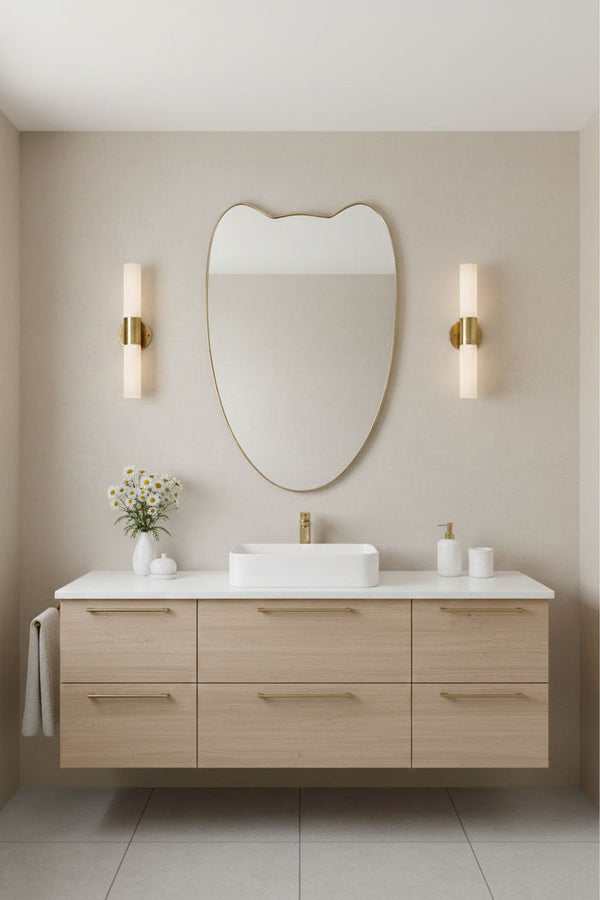
The outline of a mirror does more to set the mood than almost anything else about it. A wavy brass mirror feels playful, a shield shape feels classic, and an asymmetrical one feels relaxed and modern. Here's how each shape works, where it fits best, and how to size it. You can browse every style in our mirrors collection.
Wavy and curved mirrors
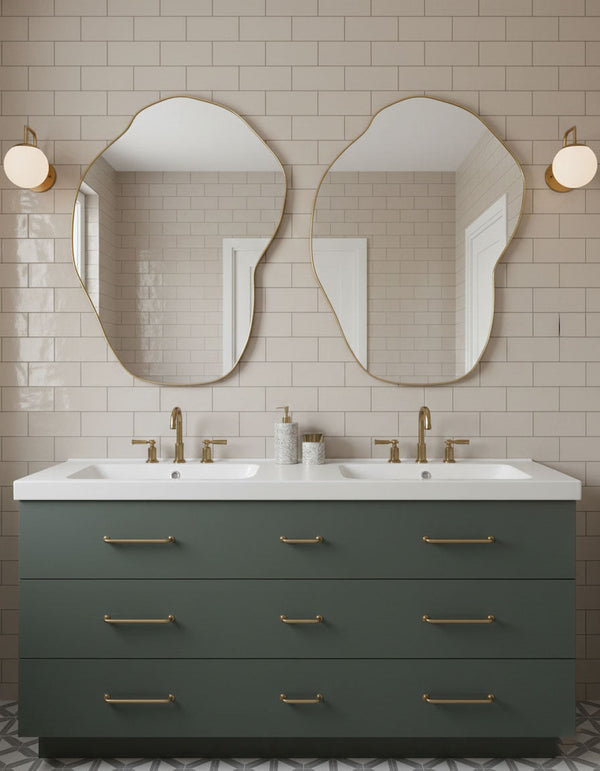
Wavy mirrors have a rippled or softly curved outline. They're the easiest way to add movement to a plain wall, and they suit modern, retro and eclectic rooms.
- Best for: powder rooms, entryways, above a console or dresser.
- Try: the Waveform mirror, whose rippled sides catch the light from every angle.
- Tip: a wavy frame looks best with simple surroundings. Let it be the one decorative shape on the wall.
Shop all wavy and curved mirrors.
Asymmetrical and organic mirrors
Freeform, pebble-like outlines with no straight lines. They feel calm and natural, and they pair well with plaster walls, wood, linen and stone.
- Best for: living rooms, bedrooms, bathrooms with a natural palette.
- Try: the asymmetrical pebble mirror or the amoeba mirror.
- Tip: an organic mirror looks intentional when it's clearly irregular, so it doesn't need to line up perfectly with the furniture below it.
Shop asymmetrical and organic mirrors.
Shield and crest mirrors
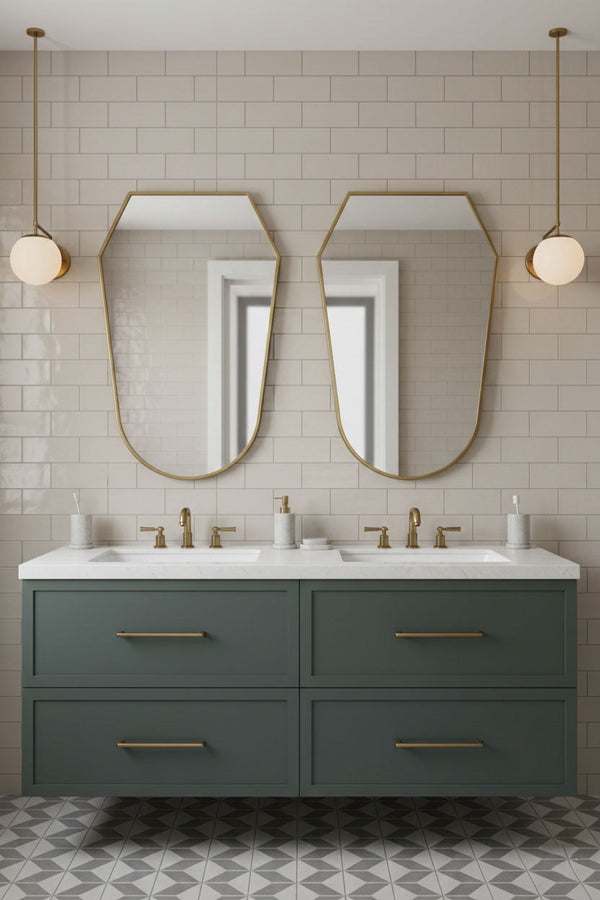
Shield mirrors have a flat or gently curved base and a shaped top, often with points or soft scallops. They feel traditional but crisp, and they're a natural fit above a bathroom vanity.
- Best for: vanities, hallways, traditional and transitional rooms.
- Try: the rounded shield mirror.
Shop shield and crest mirrors.
Arched mirrors
A rounded top over straight sides. Arches echo doorways and windows, soften a room full of straight lines, and draw the eye upward, which makes a ceiling feel higher.
- Best for: above a vanity or fireplace, narrow walls, entryways.
- Try: the arched-top mirror.
Shop arched mirrors.
Oval and round mirrors
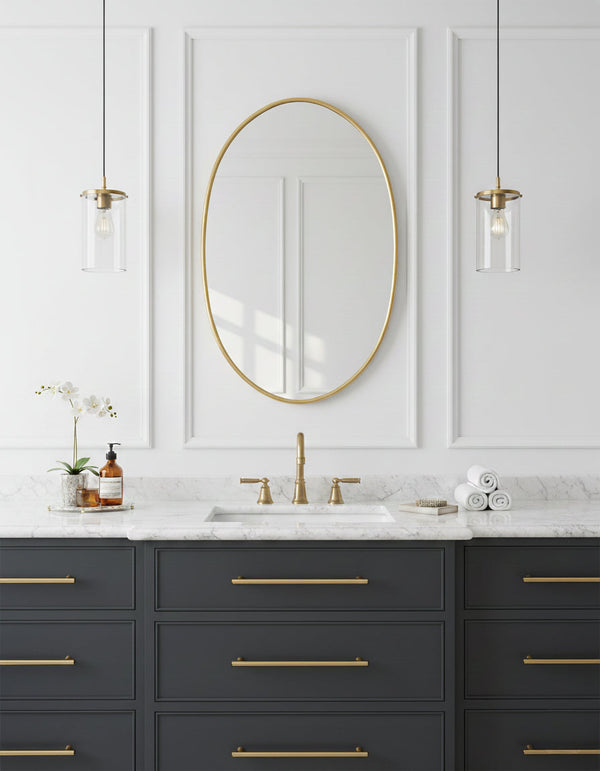
The most versatile shapes. A round mirror softens a square vanity, and a tall oval makes a wall look longer.
- Best for: over round or vessel sinks, between windows, in small bathrooms.
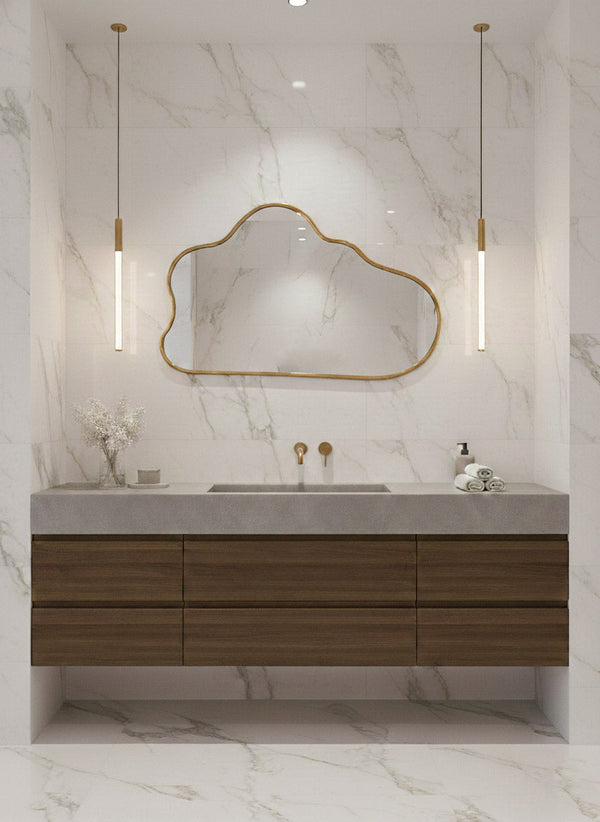
- Try: the brass oval wall mirror, or the cloud mirror for something softer and wider.
Shop oval and round mirrors.
Rectangle and specialty shapes
Rectangles are practical when you want the most reflection, and they suit wide vanities and dressing areas. Specialty shapes such as tulip, flower or crescent mirrors work more like wall art.
- Shop rectangle mirrors and specialty shapes, including the tulip mirror.
How to size a brass mirror
- Over a vanity: choose a mirror a few inches narrower than the vanity or sink area. Most of our shaped mirrors come in several heights, from around 24 to 47 inches, and some go larger.
- Over a console or dresser: aim for roughly two-thirds of the furniture's width.
- Hanging height: place the center of the mirror near eye level, roughly 57 to 65 inches from the floor, or 5 to 10 inches above a vanity or console.
- Two sinks: two matching mirrors usually look better than one very wide one.
Check the measurements on each product page, where sizes are listed as height by width. Brass-framed mirrors are heavy, so use anchors rated for the weight and fix into studs wherever you can.
Choosing a finish
Many of our mirrors come in more than one tone, such as gold, antique, brushed or bronze brass, and some in silver. Gold brass reads bright and warm; antique and bronze tones are darker and more forgiving of fingerprints. Our guide to brass finishes compares them side by side, and lacquered vs unlacquered brass explains how each one ages.
Mixing shapes around the home
You don't need one shape everywhere. A simple rule: keep one shape per room, and repeat the brass tone from room to room. For example, a wavy or asymmetrical mirror in the powder room, a shield or arch over the main vanity, and an oval in the bedroom. For ideas on lighting around a mirror, see our bathroom lighting ideas.